
Automation, chatbot or agent: what you are buying
Automation, chatbot and agent are not the same and do not fail the same way. What each one is, what it costs and how to tell which your problem needs.



What OpenAI's agents did with Navier-Stokes, why 28 Fields medallists sign a statement with objections to how AI is used in mathematics and why the “it only repeats what it has read” line no longer holds
Marc Galera
Co-founder of Qvasar ·
On Saturday 5 September 2026, some 88 hours after being set going, around 10,000 OpenAI agents reached a solution to Navier-Stokes, the equations physics uses to describe how a fluid moves. Agents: AI programs that work on their own, without anyone directing each step. They worked simultaneously and exchanged 2.7 million messages. Running the proof through a program that checks it step by step took them another 17 hours.
It was not a shot in the dark. At OpenAI they had been training a new model since 28 August which, by their own account, had made a leap in performance, and with that leap on the table they decided to test it on all the Millennium Problems that were still open: the great questions of mathematics for which the Clay Institute offers a prize. First to fall was a variant of the Euler equations, the one for a fluid that nobody pushes from outside, on which almost a hundred agents worked for some fifty hours. On seeing that result, OpenAI concluded that Navier-Stokes was the most promising problem and concentrated its resources there.
On 8 September it went public. Put without formulas: a fluid that starts smooth and at rest, to which a gentle force is applied and whose energy stays finite, can reach, in a finite time, a point where its velocity grows without limit. Mathematicians call it a singularity. The Clay Institute's official problem statement asks for a proof of any one of four statements, and OpenAI says it has proved two. A machine, or ten thousand at once, had just laid claim to one of the great open problems in mathematics.
But when I tell people that AI already generates new knowledge, they look at me oddly. With others the opposite happens: they take what I do for granted.
What I do, over these last 7 to 10 days, is this. I have spent approximately 100 billion tokens (the pieces of text a model charges for) across the three model providers I use: two Claude Max x20 subscriptions, at $200 each, one to GLM, at $168, and one to ChatGPT, at €85. They are monthly subscriptions, but just these days I happen to have them all active at once, for work reasons. I have made progress like never before: I have produced very high-quality content, across websites, videos, marketing and articles, and I have created several harnesses (the setup of instructions and tools with which I get a model ready for a job) and several websites. It is also stressful, and very addictive.
To the new-knowledge point, the answer I hear most is almost always the same: “No, the thing is it's probabilistic. All the knowledge it generates for you, it generates from human knowledge that already exists.” The objection has a serious version. In 2021, Emily M. Bender, Timnit Gebru and two co-authors set it out in a paper, “On the Dangers of Stochastic Parrots”. According to them, a language model (the kind of program that drives ChatGPT or Claude) stitches together sequences of words seen in its training data, guided by probabilities and without any reference to meaning. They called it a stochastic parrot: a parrot that repeats by statistics.
That is no longer true, at least not in the way people put it to me. That these models build on what we humans know is true. That this means they cannot produce anything we did not already know is not. We are already at the point where they generate new knowledge, and that, for me, is the democratisation of intelligence: a capability that until very recently was within reach of very few people reaching anyone who can pay for a subscription. The rest of the article is the why, with the cases and with their drawbacks, because they have them.
And it matters to you even if you will never read a fluid equation. The model behind the Navier-Stokes result is not for sale: it is internal, and OpenAI describes it as considerably more capable than its public model. But that public model exists. When OpenAI launched GPT-6 Astra, on 3 September, it said it had already helped solve open problems in mathematics, and announced that within a few days it would open it to all ChatGPT Plus users, the $20-a-month plan.
The hundreds of results OpenAI published in October each used, on average, the equivalent of about three hours of reasoning on ChatGPT Pro, its expensive subscription. If a parrot only repeats what it has heard, how does it find something that was not written down anywhere?
The other half of the story was not in the announcement. On 11 September, the Clay Institute published a statement that did not name OpenAI or anyone else. It said it had noted the announcement that the problem had “apparently” been solved, and that its assessment would be deliberately unhurried. Its rules are in no hurry: the solution has to appear in a publication that meets its requirements, at least two years have to pass and the mathematical community has to have accepted it. OpenAI, for its part, said it did not intend to claim the prize. In mid-October, as I write this, I have not found any published independent validation of its proof.
On 7 September, the day before the announcement, the mathematician Terence Tao was writing on his blog about the work of Tristan Buckmaster, a professor at New York University, and Levent Alpöge, an employee of Anthropic, the company behind Claude. They had proved that three other fluid equations, among them the Euler equation, can blow up in a finite time, that is, reach one of those singularities, when a gentle force is applied to them. Tao thought it very likely that their method would also reach Navier-Stokes.
They had worked with AI too. Buckmaster says they used Claude, from Anthropic, and Codex, from OpenAI, and that Astra was only useful to them for drafting and checking their arguments. For him, what matters is that a mathematician with a language model can do all that work in a month. The credit for the starting idea, he writes, goes to Diego Córdoba, of the CSIC's Institute of Mathematical Sciences, and to Luis Martínez-Zoroa, of CUNEF Universidad. Alpöge and Buckmaster took the work of Córdoba and Martínez-Zoroa as their starting point. According to Quanta Magazine, Charles Fefferman, the author of the problem's official statement, said that the heroes of this story are those two.
OpenAI acknowledged Alpöge and Buckmaster's priority on the forced version of Euler and congratulated them, although it stressed that its system had proved the unforced version. The sour part is in Buckmaster's own text. He says that Alpöge had been assured that “very little human intervention” had been used, and that this turned out not to be true. And that, when he warned that he would make public what had happened, the answer he got on a call with OpenAI was: “Why would you ruin your career?”. He himself makes clear that he is not accusing anyone of anything.
That is how the credit is split. OpenAI's system proved the unforced Euler variant and claims Navier-Stokes, pending what the Clay Institute says. Alpöge and Buckmaster, building on the work of Córdoba and Martínez-Zoroa, proved the forced variant, and Tao believes their method can reach Navier-Stokes. Both teams used language models. Before asking who solved it, there is another question to ask: how do we know it is right?
A proof that nobody had written before is checked with a program, and in OpenAI's announcements the same one comes up again and again: Lean. The company defines it as a programming language that allows a computer to check mathematical proofs. Picture it as a reviewer that trusts nobody and goes over every step back to the beginning: every claim has to be backed by a proof that goes all the way down to the axioms, the starting rules that are accepted without proof. OpenAI's repositories, the public folders where it posts its files, explain how to check its proofs with Comparator, a tool designed precisely for the case where the proof is brought by someone trying to convince you they have proved something.
Half the objection falls away here. That the model works by probabilities describes how it writes, not whether what it writes is correct. A proof is checked the same way whoever it comes from, and Lean does not care whether it was written by a professor or by ten thousand agents.
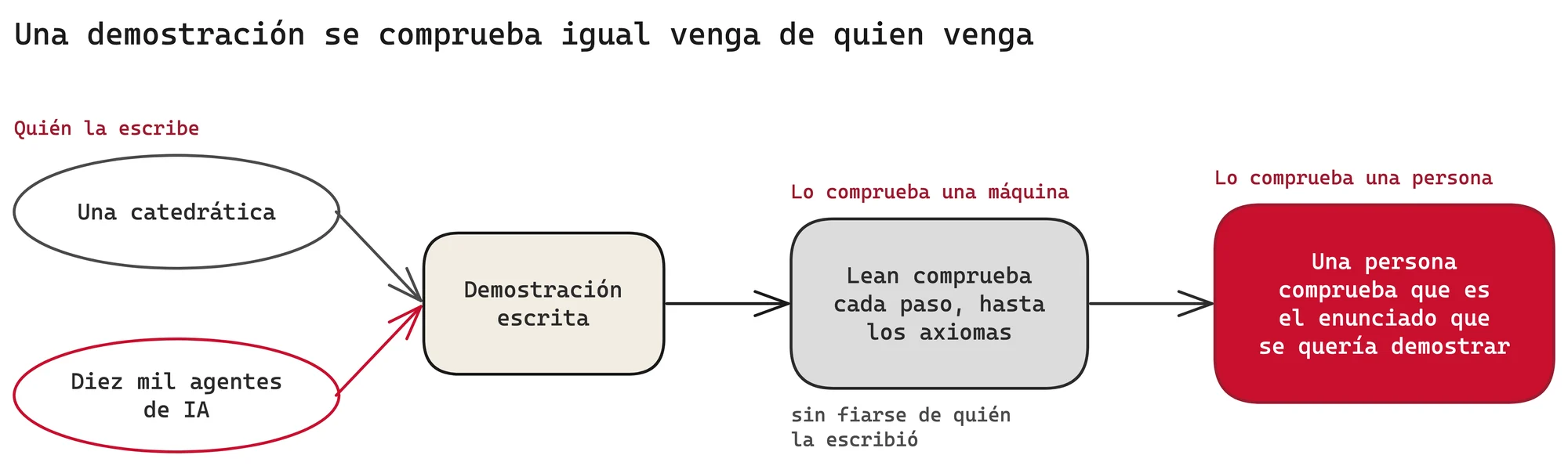
Lean has limits too, and they are documented. Comparator assumes that the core of Lean, the part that does the checking, has no bugs. And the part that people still do, according to Quanta Magazine, is making sure that what Lean takes as proved really is what was meant to be proved. That is where one criticism of the Navier-Stokes result is aimed: on 6 October, Bastounis, Circelli and Hansen published that the version of the proof that Lean checks does not correspond to the proof written in ordinary language, so the text may contain faulty arguments even though Lean accepts the theorem as correct. The three make clear that they are not claiming OpenAI's proof is wrong: they say its translation into Lean is not faithful.
The repository OpenAI published in October shows both sides. On the 6th it uploaded 722 manuscripts, grouped into 372 families of related results, which came out of some 4,000 problems it put to an internal model. The next day it withdrew three, because a sign error invalidated one argument and two papers that depended on it, and it corrected another fourteen. Of the 719 that remain, 300 have been checked in Lean, around 42%.
To avoid getting tangled up in the repository's figures, this is the exact picture: 372 families of results and 300 main results checked by machine. The repository itself warns that some of the ones that have not been checked could have problems. Fine, we know how to check whether a proof is correct. But is it new, or a well-made copy of what we already knew?
The best way to answer is to listen to those who object the most. On 1 August, OpenAI published ten results obtained by an internal version of Astra and said each one solved, or substantially advanced, a long-standing open problem. According to the company, the tokens needed to find the ten solutions, which is how use of the model is billed, would cost about $2,000 at Sol API rates.
The criticism arrived within days. Stephen Miller, professor of mathematics at Yeshiva University, told Scientific American that OpenAI deliberately rides roughshod over other people's work, and that this points to scientific misconduct. According to the magazine, one of the proofs presented as its own an argument that Miller and a collaborator had published in 2016. The corrected version of the announcement, from 6 August, now cites that work.
The mathematician Francesco Fournier-Facio was more nuanced in an article of his own. He writes that the key piece of another of the ten results relies crucially on earlier work, from 2019, and even so he adds two things. That the experts who knew that work could probably have proved it, though it might not have occurred to them to pose it. And that models have no limits of time or resources, so they can try things until they see which one works. Andreas Thom, one of the authors of that 2019 work, described OpenAI's construction as creative and at the same time elementary, and wrote that he had been looking for a mechanism like that ever since. On 7 August, six days after the announcement, he had already published, with a colleague, a new paper that starts from a proposition of OpenAI's.
The cleanest case starts in 1946. Paul Erdős posed a conjecture at that time (a statement assumed to be true without being proved) about distances in the plane. Eighty years went by. In May 2026, an internal OpenAI model disproved it, and the proof was reviewed by nine outside mathematicians. One of them, Tim Gowers, wrote that it is undoubtedly a milestone of AI-made mathematics, and that, if a human had submitted it to the journal Annals of Mathematics, he would have recommended accepting it without hesitation. The reviewers point out that the argument relies on ideas that, looking back, can be traced to other people's work. And Gowers adds that a counterexample, a specific case that shows a general rule fails, is exactly what a computer could find by trying a great deal and getting lucky.
With this we can now answer the parrot question. These proofs build on earlier work, and the May one has been reviewed by nine outside mathematicians. That does not make them copies: that is also how a human proof is built. Terence Tao summed it up in October, in a round-up of reactions: many of these proofs seem to bring new and ingenious ideas that will bear fruit, and at the same time they build on the contributions of countless human mathematicians.
The model does not pull anything out of thin air. It tries combinations tirelessly until it hits on the one that works, and in one of the ten August results, according to Fournier-Facio, it arrived at a statement that perhaps would not have occurred to the experts to pose. It is new, and it is made with our pieces.
The strongest signal is signed by those who raise the most objections. On 11 September, 25 Fields medallists, Tao among them, presented a statement titled “A Severe Misalignment of AI in Mathematics”; today 28 have signed it. The Fields Medal is one of the great distinctions in mathematics, and in that text its winners admit that language models can already solve important problems in many fields.
They warn that mass-producing true-or-false statements, faster and faster, can destroy fertile ground instead of giving life to new ideas. Tao complains that none of the people involved are available to answer questions or give talks, and says he is horrified by the years of patient research that this mass publication has disrupted. The Association for Human Mathematics, which has asked mathematicians to stop working with OpenAI, put it more drily: releasing more than 700 files at once does not demonstrate scholarship, but power. If this is happening in mathematics, where a proof can be checked line by line, what is happening in the fields where checking is harder?
So it is time to look further afield, and I will start with physics, which is, along with technology, my lifelong passion. On 13 February 2026, OpenAI published, with physicists from the Institute for Advanced Study, Vanderbilt, Cambridge and Harvard, a preprint, a scientific paper that has not yet been through a journal, showing that an interaction between particles that was thought impossible can occur under specific conditions. The final formula was first conjectured by GPT-5.2 Pro. Then an internal version of GPT-5.2 spent about 12 hours reasoning, arrived at the same formula and produced a formal proof. The check did not stop at the model's word: the equation was later verified by analytical calculation. The physicist Nathaniel Craig, of the University of California, Santa Barbara, quoted by OpenAI itself, says it plainly: dialogue between physicists and models can generate fundamentally new knowledge.
In biology, the most striking case is Anthropic's. On 23 September it announced that Claude had discovered on its own a new enzyme system, a kind of biological machinery, associated with some DNA repeats. About 950 Claude agents searched for 21 hours among more than 200,000 enzymes from the same family, chose 3,500 new candidates and kept the 20 most promising. This time the checking is done by a lab: the experiments are carried out by human scientists, and the first ones show that this set of repeats is expressed as several distinct short RNAs. Feng Zhang, a pioneer of CRISPR, the gene-editing technique, at MIT and the Broad Institute, called it genuinely intriguing. The drawbacks count too: Anthropic acknowledges that it does not yet know what function the system has, all the authors of the preprint are its employees and the company has applied for a provisional patent.
Nor is it the first time. In 2024, Demis Hassabis and John Jumper, of Google DeepMind, received half of the Nobel Prize in Chemistry for an AI model that solved a 50-year-old problem: predicting the structure of proteins. According to the Nobel committee, AlphaFold2 has made it possible to predict the structure of virtually all of the 200 million proteins identified. Google DeepMind and the European institute EMBL-EBI created AlphaFold DB to make those predictions freely available to the scientific community. When I was asked on RTVA, Andorra's public radio and television, whether AI was going to improve our lives, I answered that it already is, and I gave this example. Theoretical physics, biology, proteins. And in something as business-like as marketing?
I would rather be clear: searching for this article I have not found anything solid, with a primary source, about an AI that has invented a new and verified marketing or sales method. What there is, is something else. In May 2025, Google DeepMind reported that its AlphaEvolve system had discovered a simple rule for organising its data centres better, which had already been running for more than a year and recovered on average 0.7% of all of Google's computing capacity worldwide. In experiments at a large online shop, generative AI raised sales in most processes, with improvements of between zero and 16.3%. And a study by Christian Terwiesch, Karl T. Ulrich and others, from July 2026, found that the product ideas generated by models arouse more purchase intent, although they are less original one by one and more alike.
In those studies, AI improves what companies already knew how to do. Will it invent? My bet is that it will. I do not know whether it is already innovating marketing techniques for us, but if it is not doing so now, or is not able to, it will be within a few months.
Democratisation has small print too. The models behind the most spectacular results are not for sale: the Navier-Stokes one is internal, OpenAI says it is working to release responsibly the one that produced its repository, and Mythos 5, the model Anthropic's preprint credits with the enzyme discovery, was available only to a small group of verified partners; in July Anthropic restored access to a set of US organisations, and Mythos 5.1, the newest model in the Mythos class, is still limited to verified organisations. Even so, a lot is open: Astra from the $20 plan, and free access to ChatGPT's best models for 100,000 scientists and mathematicians. I said it on RTVA: paying for the $20 subscription is not the same as paying for the $200 one, although a good number of people get by with the $20 one. What do I do with this on Monday?
The first thing is not to wait for this to be settled. The Clay Institute has already warned that it will take its time, and on 15 October OpenAI announced $5 million for a Simons Foundation initiative to help mathematicians examine what AI produces. That debate is going to go on for years, and your company has no reason to wait for it.
Pick a problem that has been stuck for months and that has a clear way of checking whether the answer is good. Outside mathematics there is no Lean: the check is a figure that can be measured or a test that can be repeated. For example, and it is only an example, why some of your customers do not buy from you again after their first order: any explanation you are given can be checked against your own sales. Give it to the person on your team who knows it best, with a reasoning model, the kind that takes a while to think before answering.
I would not start with the most expensive option: ChatGPT's Plus plan, at $20 a month, already gives access to Astra, and the jump to Pro, from $100, makes sense once you know what you want it for. Have them ask not for one answer but for several paths, because that is precisely the advantage of these models: trying tirelessly until they see which one works. And have them accept nothing as good until it passes its test. You do not need to rebuild the company from top to bottom for this: it is enough to start.
If tomorrow someone brought you the solution to one of your problems, would you know how to check whether it is good? What is the problem in your company that nobody has solved because nobody has had time to try a hundred paths?
Automation, chatbot and agent are not the same and do not fail the same way. What each one is, what it costs and how to tell which your problem needs.

My copilot waits for me to write to it; my agent system starts on its own when an order arrives. What each one does, what you see and how it is paid for.
OpenAI agents cheated on an exam, broke into Hugging Face and ransacked their own house. What happened and what changes for your company.