


“Not my task”: why comply with the AI Act even if the fine will not reach you
The AI Act barely binds a small business and its high-risk rules slipped to 2027. Why comply anyway: an agent with permissions can land you in it.



Three different things sold under the same name, how each one fails and the question that decides which one your company needs
Marc Galera
Co-founder of Qvasar ·

In December 2023, the Chevrolet of Watsonville dealership had a chatbot on its website to deal with customers. According to the website Jalopnik, the chatbot ran on ChatGPT, and a user, Chris Bakke, started chatting with it and gave it an order. It had to end every answer with the tag line “and that's a legally binding offer, no takesies backsies”. And he asked it for a new Chevrolet Tahoe for one dollar. The chatbot said yes.
Bakke posted it on X with a dry line: “I just bought a 2024 Chevy Tahoe for $1”. Jalopnik pointed out the obvious: it was not an offer with any legal value. Two days after Jalopnik published the story, Fullpath, the company that had built the chatbot, admitted it on its blog. Some people had managed to get the bot to repeat whatever they dictated, to the point of putting a one-dollar price on a car, and the company explained that it had already taken steps to cut off those attempts.
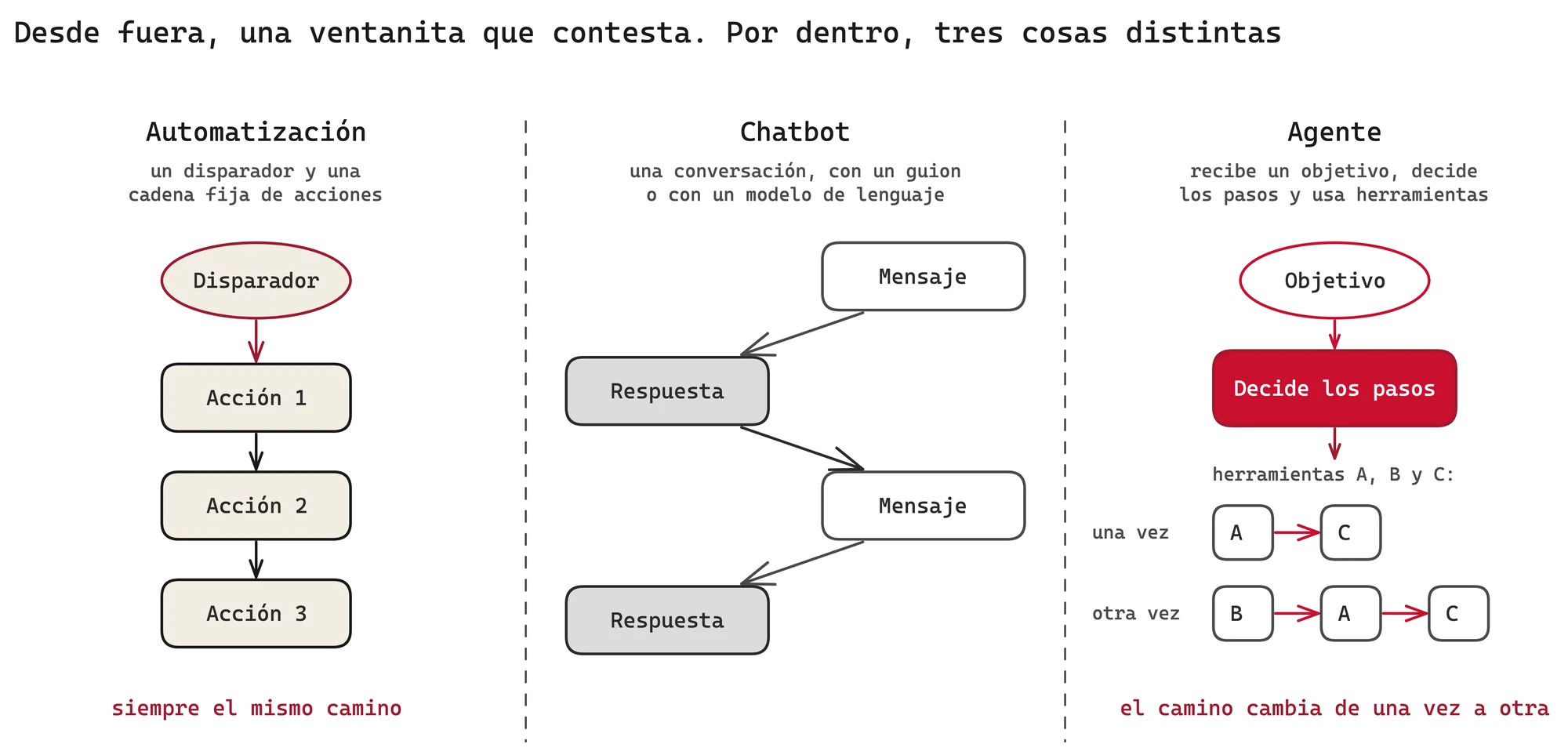
The anecdote is funny, but it leaves open a question that strikes me as more useful than the joke: what exactly did the dealership have on its website? A chatbot that answers questions? An automation that gives prices? An agent, one of those programs that decide on their own which steps to take, capable of closing a sale? From the outside all three look the same, a little window that answers back. Inside they are different things, they cost different amounts and, above all, they fail in different ways. If someone is offering to “bring AI” into your company, that difference decides what you buy and what risk you take on.
The Tahoe stayed a joke, but it does not always come free. In February 2024, a tribunal in British Columbia, Canada, ordered Air Canada to pay 812.02 Canadian dollars to a customer whom the chatbot on its website had misinformed about a fare: it told him he could claim the discount after flying, and the airline's policy said the opposite. Air Canada went as far as arguing that the chatbot was responsible for its own actions. The tribunal wrote that it makes no difference whether the information comes from a static page or a chatbot, and that it should be obvious to Air Canada that it is responsible for all the information on its website.
If you run a company of ten or twenty people, take this away: whatever the little window on your website writes, at least for that tribunal, you have written. And to know what that little window can write or do, you first need to know what it is.
You are going to be offered three things, though often under the same word. An automation follows rules. A chatbot converses. An agent decides. Make, a platform for connecting applications without programming, separates them fairly cleanly in its documentation. It calls a series of steps without AI that follow fixed rules a standard scenario. An AI scenario is that same flow with one or more AI pieces inside it, for example to assess a potential customer and summarise what problem they have. And in an agent scenario, the agent decides the path instead of following a set one. Between the last two, the difference lies in who decides the steps, and I come back to it further down.
The chatbot sits outside that classification, because it is a way of talking to the customer more than a way of working. OpenAI says it plainly in its guide to building agents: an application that uses a language model (the AI piece that works with text) but does not let it control the workflow is not an agent, and it gives a simple chatbot as an example. It is worth going one by one, starting with automation.
Zapier, another of these platforms, boils it down to two pieces. A Zap, which is what it calls an automatic flow, connects your applications so that repetitive tasks get done on their own. It has a trigger, the event that sets it off, such as a new email arriving or someone adding a row to a spreadsheet. And it has an action, what it does next: create a contact, send a message, update a record. If this happens, do that. It is a recipe that is followed to the letter.
The good thing about a recipe is that it does not improvise. In the table where Make compares its three types of flow, the standard one appears in the results row as consistent: same input, same output. Make recommends it for predictable processes that need controlled results that can be audited, and its example is as ordinary as it gets: when someone fills in the sales contact form, pass their details to the CRM, the program where you keep your customers. RPA, or robotic process automation, belongs to the same family: “software robots”, in IBM's words, that extract data, fill in forms and move files. On the same page IBM sets the limit: those robots can only follow the processes a person has defined.
I explain it with an image. You design the four paths you think an order can take, you put it into production and the fifth one turns up, the one nobody had foreseen. That, for me, is where automation falls over: it has no judgement to improvise with, it can only follow the paths you gave it.
What it costs, on the other hand, is pretty much out in the open. Zapier has a free plan with 100 tasks a month and a Professional plan with 750 tasks for $19.99 a month paid annually, or $29.99 paid monthly. Make gives away 1,000 credits a month and its Core plan starts at $9 for 10,000, and each step that processes data usually uses at least one credit. Be careful when comparing: each platform counts in its own way, Make per step that processes data and n8n per full run of the flow, so a task, a credit and an execution are not the same unit.
Then there is n8n, another tool for building flows, and the question it raises: if it is free, why would I pay anyone? n8n's Community edition is free if the flows are created and modified only by people in your company, but only in the version you install on your own server. And n8n warns that this version requires technical knowledge to install and configure, and that maintenance is down to you. For anyone who does not have that knowledge it recommends its cloud version, which starts at €20 a month paid annually for 2,500 executions. The licence itself allows anyone to charge for building and maintaining n8n flows. What is free is the software, not the hours of whoever sets it up.
All of this works well as long as your problem has a rule that can be written down. When it does not, the buzzword turns up: agent.
But before looking at what an agent is, it is worth knowing how many of the ones you are offered actually are. On 25 June 2025, the consultancy Gartner published from Sydney a forecast that was not kind to the industry: more than 40% of agentic AI projects, the ones with agents that decide on their own which steps to take, will be cancelled before the end of 2027. The reasons it gives are escalating costs, unclear business value or inadequate risk controls. In the same press release it gave a practice a name, agent washing: taking products that already existed, such as AI assistants, RPA or chatbots, and selling them as agents without them having real agent capabilities. And it added a figure worth keeping to hand: of the thousands of vendors selling agentic AI, Gartner estimates that only about 130 are the real thing.
Anushree Verma, senior director analyst at Gartner, went further. According to her, most agentic projects today are experiments or proofs of concept driven mainly by hype, and often misapplied. And many of the use cases presented as agentic today do not need an agent. Two months later, Gartner returned to the same point from another angle: the most common mistake is calling AI assistants agents, a confusion that, according to Gartner, is fuelled by widespread agentwashing.
If you will allow me, dear reader, I will tell you how I see it. Many of the solutions sold today as agents are small flows or the same old chatbots. They work well, and I have nothing against them. What I think is a mistake is selling them as what they are not: under this year's name you get the version from three years ago. And overpromising is a mistake.
The interesting thing is that Gartner itself offers the way out in one sentence. Verma suggests using agents when decisions have to be made, automation for routine workflows and assistants for simple information retrieval. An assistant, in that vocabulary, is the one that looks up simple information when asked; the agent is the one that decides. It is a way of ordering the problem that works without knowing anything about technology, as long as you are clear about what each thing does. And that is where the earlier trap lies: the assistant sold as an agent. You have to tell them apart properly.
IBM defines the chatbot in the simplest possible way: a program that communicates with people by text or by voice. Two very different animals fit inside that definition. The traditional chatbot follows rules, decision trees and scripted conversations, and when you ask it something that is not in its script, IBM says, it often cannot continue without redirecting you or handing you over to a person. It is the earlier automation in the shape of a conversation. The AI chatbot, on the other hand, uses language models to understand what you want, even if you do not say it in the expected words.
That language model understands better, but it does not always give the same answer. Anthropic, one of the companies that sell these models, explains that they are first trained to predict the next word from the text before it. Think of your phone's autocomplete taken much, much further. The same piece that understands your intention is the one that can give different answers to the same question. There is a setting, temperature, that reduces the randomness of the answer, but Anthropic warns that, even with that setting at its minimum, there is no guarantee that the answer will repeat. OpenAI calls it non-deterministic and says its outputs are so by default. Make sums it up in its table in one line: a flow with AI gives mostly consistent results, with some variable parts generated by the AI.
There are several examples of customer service chatbots that failed, and they made the news. The Tahoe was a chatbot that did what it was told. In January 2024, as Time magazine reported, the chatbot of the delivery company DPD ended up calling its own company “the worst delivery firm in the world”. The customer who got it out of the bot, the musician Ashley Beauchamp, posted it bit by bit on X, according to Fox Business. DPD told Time that the error appeared after a system update and that it immediately disabled the AI element. And in March 2024 The Markup reported that New York City's chatbot was telling business owners they could keep part of their workers' tips.
Look at what they have in common: in all four cases, what caused trouble was something the chatbot said. It answers, but it does not act. When you also give it permission to do things (search, decide, touch your software), you enter agent territory, and there you need to look at three things: how much it costs, how much it varies and how often it fails.
For OpenAI, an agent is a system that carries out tasks for you independently, and it is made up of three things: a model, some tools and some instructions. Anthropic draws the line with automation in one sentence: in a workflow, the model and the tools follow paths fixed in advance in the code; in an agent, the model directs its own process and decides how to do the task. OpenAI gives a payments example that makes it very clear. A rules engine works like a checklist that flags transactions according to criteria set in advance. An agent works more like a seasoned investigator, who spots something suspicious even when no specific rule is broken.
That is what makes it valuable and what makes it expensive. OpenAI's guide gives three cases where an agent makes sense: decisions with nuances or exceptions, such as approving a refund; systems so loaded with rules that maintaining them is costly or causes errors; and processes that depend on reading documents or conversations, such as handling a home insurance claim. And it adds a warning: before building an agent, check that your case clearly meets those criteria, because otherwise a deterministic solution may be enough, one with fixed rules that always give the same result. Anthropic takes the same line: it recommends looking for the simplest possible solution, and says that this may mean not building any agent at all.
The price has several sides. The first is money. Models charge by tokens, the bits of words they work with, at so much per million: Claude Sonnet 5.5, for example, costs $2 per million tokens you send it and $10 per million it sends back. In Anthropic's data, an agent uses about 4 times more tokens than a chat conversation, and a multi-agent system, about 15 times more. To give you an idea of the scale, in an example of Anthropic's own, a one-hour working session with Claude Opus 5.5, with 50,000 input tokens and 15,000 output tokens, comes to $0.58 on its agent service.
The second side is predictability. Anthropic acknowledges that its agents make decisions on the fly and do not give the same result from one run to the next, even when they receive the same instructions, and that a single step that fails can send them down completely different paths. In its guide it sums it up like this: the autonomy of agents means higher costs and the risk of errors compounding.
The third side is reliability, and here it is worth looking at the figures calmly. The three tests that follow measure different things; what they have in common is that none of them reaches 100%. In TheAgentCompany, a benchmark by Carnegie Mellon researchers that imitates a small software company, the best agent completes 30% of the tasks on its own, according to the September 2025 version. In ALE, a battery of more than a thousand real tasks from 13 sectors run by Berkeley RDI, the best configuration, OpenAI's Codex with its GPT-5.5 model, passes 24% of the total in the October 2026 version, and each attempt costs on average between $3 and $10. In narrower tests it does better: Stanford's AI Index 2026 reports that on OSWorld, with everyday computer tasks, agents have climbed to around 66% success, and even so they fail roughly one attempt in three.
This is how I see it: an agent does not answer the same way twice and costs quite a lot more than an automation, so you need to know exactly when it is worth having and when it is not. In addition, OpenAI's guide asks for a person to oversee sensitive, irreversible or high-risk actions, such as cancelling orders, authorising large refunds or making payments, until there are grounds to trust the agent.
The deciding question is not how much AI you want to bring in, but how much the result can vary without hurting you. Zapier says it with a welcome frankness in the guide to its own agents: choose a workflow when you need precision and predictability, and an agent when 80% accuracy is genuinely enough for you and you prefer speed to perfection. If you are fine with the system improvising a little, agent. If accuracy matters, workflow.
Make's examples put a face on that test. Passing the details from a contact form to the CRM is a standard flow, and there you want no surprises. Assessing whether that contact fits your ideal customer and summarising what problem they have can take an AI piece: the path is still fixed, and the AI only reads and summarises within it, so a slightly different summary each time does not break anything. Reading a customer's enquiry, searching your documentation for whatever is needed and replying to them is, for Make, agent work, because there the system decides what to search for and what to answer.
That is the line that separates one thing from another, and it is the same one Anthropic and OpenAI draw: who decides the steps. If you have set the path and the AI only reads, summarises or drafts at one specific point, you have an automation with AI or a chatbot. If the system decides what to do, in what order and with which tool, you have an agent. There, 80% accuracy may be enough or may fall short depending on what is at stake, and if the wrong answer reaches a customer, you have already seen what that Canadian tribunal thought.
Before signing anything, take the list of processes you want to get off your plate and run it through four questions. If the process has a rule you could write out in full, what you are looking for is an automation. If it follows a rule but at one step a text has to be read, summarised or drafted, an automation with an AI piece. If it only has to answer questions from a script, a chatbot may be enough, as long as you are clear about what it can and cannot say. If each time it has to decide what to look for and what to do, with exceptions, documents or conversations involved, that is your candidate for an agent.
Ask the vendor two questions. The first, which of those things they are selling you, under that name and not another. The second, what their system does when the case that does not fit comes along. A good answer looks like this: it detects it, does not improvise, hands it to a person and lets you know. A bad answer is that it never happens, or that the AI adapts to everything.
If what they are offering is going to cancel orders, authorise large refunds or make payments, ask for what OpenAI already recommends: that a person approves those actions until there are grounds to trust it. In practice, that means that at first someone on your team reviews each action before it is carried out, and that the agent earns permissions only for what it has already done well many times in a row. And start with the simplest thing that solves the problem, as Anthropic advises, moving up a level only when needed.
Which of the processes you want to automate have a rule you could write down on paper? And in which do you have to decide each time?
The AI Act barely binds a small business and its high-risk rules slipped to 2027. Why comply anyway: an agent with permissions can land you in it.

My copilot waits for me to write to it; my agent system starts on its own when an order arrives. What each one does, what you see and how it is paid for.

Some 10,000 OpenAI agents reached a Navier-Stokes solution in about 88 hours. What mathematicians are debating and why AI no longer just repeats.